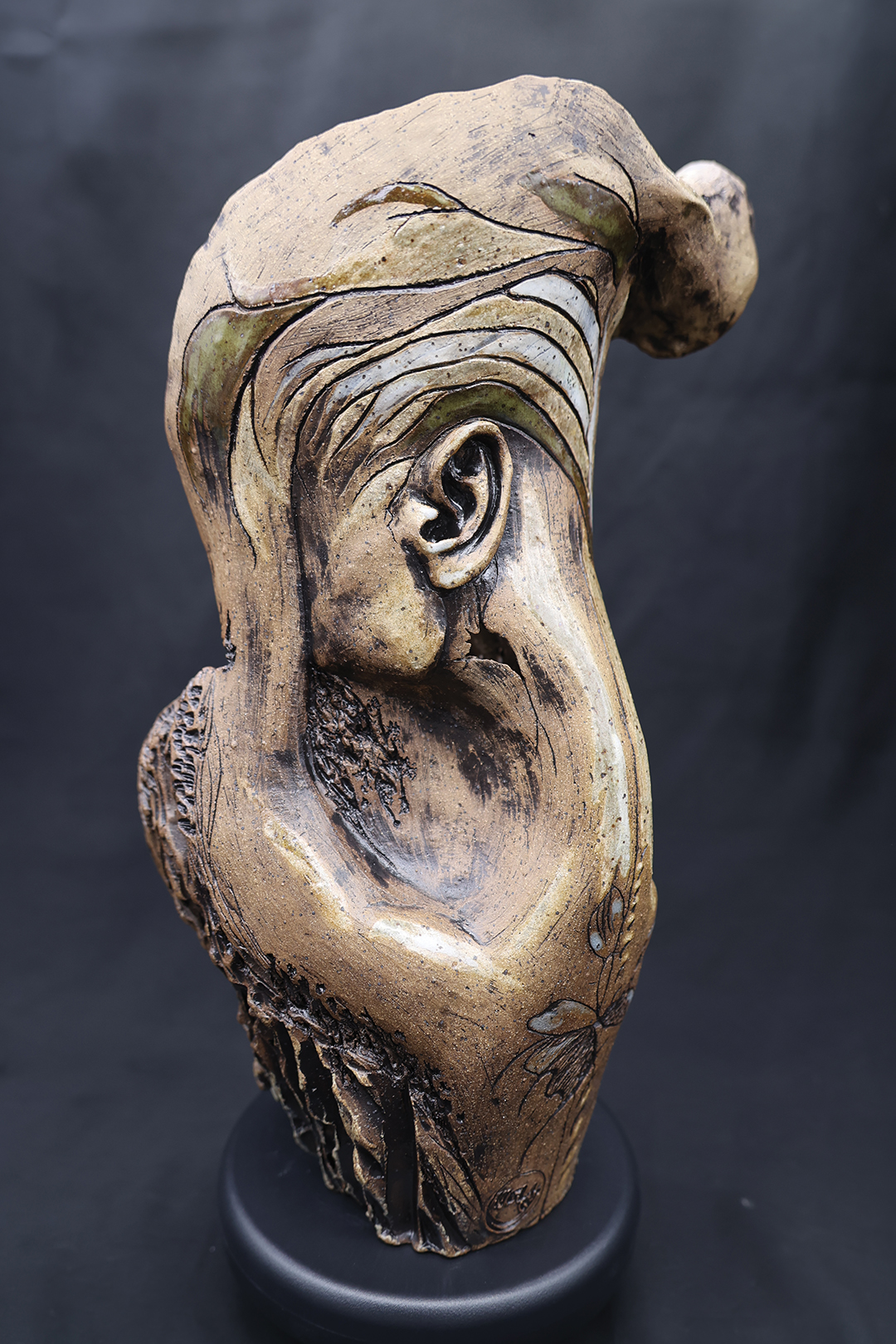
One of Melissa Wilcox’s untitled stoneware sculptures—standing 16 inches—blends organic forms with human anatomy, evoking the connection between body and nature. This sculpture has sold. Photos: Bob Lyksett
An artist’s sculptural pottery reflects nature and humanity.
Melissa Wilcox has always felt inspired by nature. “I grew up in the country, so a lot of stuff is nature-oriented,” she says. The Woodbury resident has long appreciated the organic shapes, elements and textures of the world—and also those of the human body.
For more than 25 years, Wilcox has worked as a pathology assistant at Children’s Minnesota, where she also studies tissue and performs autopsies. For the past 15 years, she has been a part-time potter, enjoying the art form in her spare time. Between her work and raising a daughter and stepdaughters with husband Scot Wilcox, she says there hasn’t been much time to be creative. “Now, I have the opportunity to expand on this more,” she says. This month, Wilcox retires from Children’s Minnesota to pursue pottery full time. “[I’ve] had a career that I couldn’t have gotten anywhere else,” she says. “I have an opportunity to try something new.”
A Balancing Act
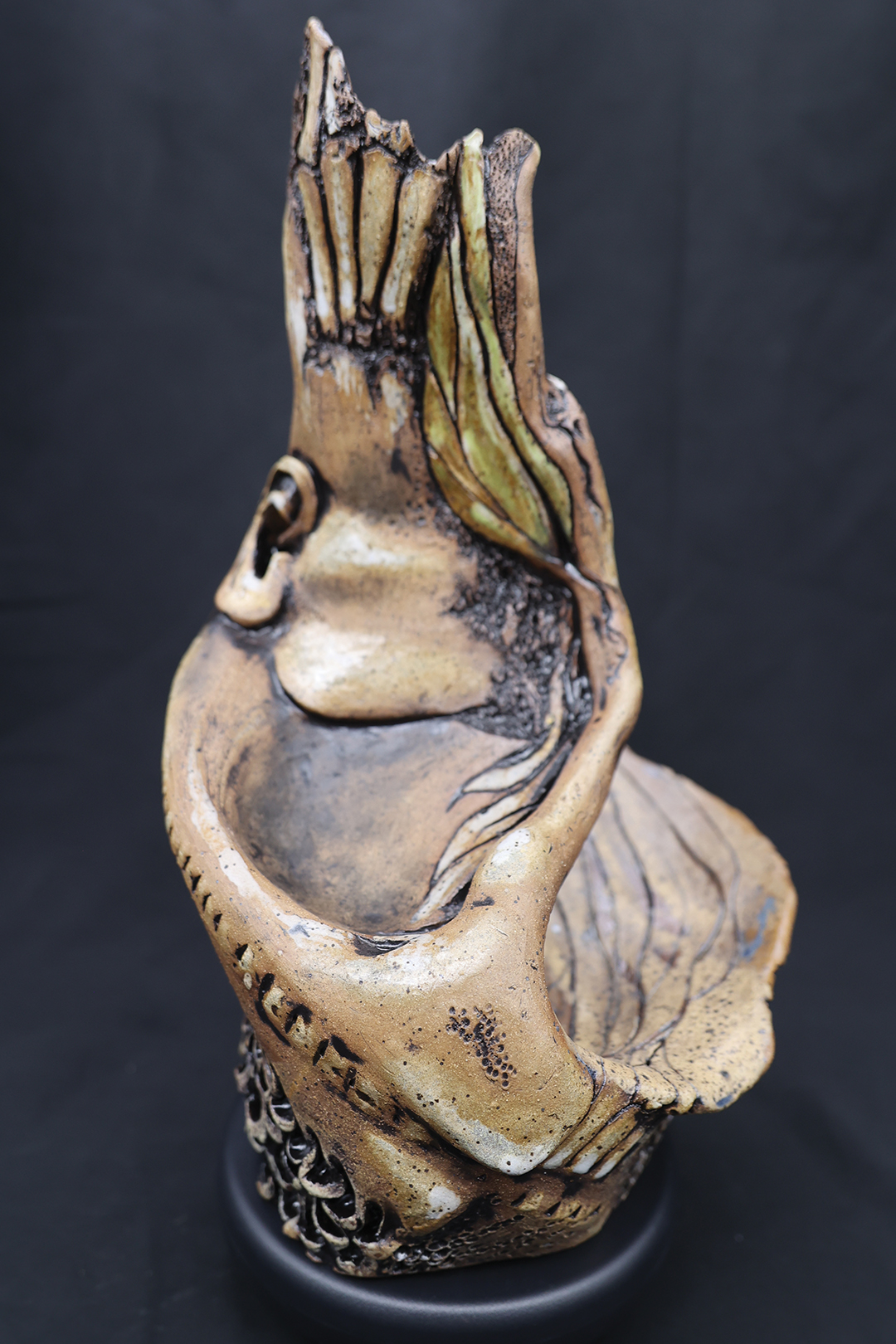
Wilcox’s pottery, although food safe, leans more sculptural. She is inspired by the beauty of nature and humanity, and her pieces often take on forms of human skeletal structures. “It’s not blatant, but it’s part of the natural aspect of it,” Wilcox says. “Honestly, it sounds bizarre. I don’t sit down and design these. It’s what the clay looks like in my brain. How I throw the pot, how I push or move it, it might resemble a ribcage [or] a spine. Everything is very raw … [It’s] the fluidity of it, the human form, the flowers, how delicate it can all be. I enjoy the comparisons.”
Balancing the line between being a pathology assistant and a potter has been challenging, Wilcox says, but the two have influenced one another tremendously. “I’ve always found beauty in human form from [an artistic perspective] but, anatomically, I’ve had experience with that as well,” she says. “It’s about trying to find the beautiful aspect of it [and] how everything moves together. The asymmetry of it … I think it’s always been my zen.”
Wilcox describes her in-home studio as the place where she can step away and lose herself, describing the space as an outlet. Sometimes there may be as few as 10 pieces sitting on the racks, ready to be put in the kiln in her garage. Other times, up to 50 pieces sit on the racks. That number could rise as Wilcox steps into pottery full time.
A Natural Evolution
Her pottery has evolved throughout the years, and each piece tells a different story. One piece in particular has stayed with Wilcox. “My favorite piece I’ve ever made, I sold. It was something that I’ve attempted to recreate, and it’s been sort of successful,” she says. “It was a piece where I … pushed [the clay] all in and wrapped it around. It was a human form with a back and a hand exposed. Then, on the opposite side, was a lily. The colors and how it burned, how the glaze was, it was spot on, perfect … I’ve had a number of loves. I keep them with me until I decide they can find a new home.”
Each piece speaks for itself, and, although they’re similar, Wilcox describes them all as very different. “Some forms might resemble each other, but every piece is a little different, whether in color or size,” she says.
Looking toward the future, Wilcox is excited for her evolution as an artist. “My pottery speaks of my evolution, who I’m becoming and who I’m excited to be,” Wilcox says. “I hope that love and what I appreciate are translated to other people.”
On Display
Melissa Wilcox’s pottery is displayed at the Stillwater Art Guild Gallery (artguildgallery.com) and in the new year, Wilcox is hopeful to attend as many art events as possible. “I greatly enjoy all the questions and talking to people,” she says. Wilcox recalls a particular moment when a peruser thought her pottery was made from wood. “He figured he for sure knew what wood I was using. I said, ‘It’s clay,’ and he looked super confused,” she recalls. “To start conversations and have people interested in pottery and the colors I use … It’s so fun.”
Melissa Wilcox
Instagram: @mela.pottery