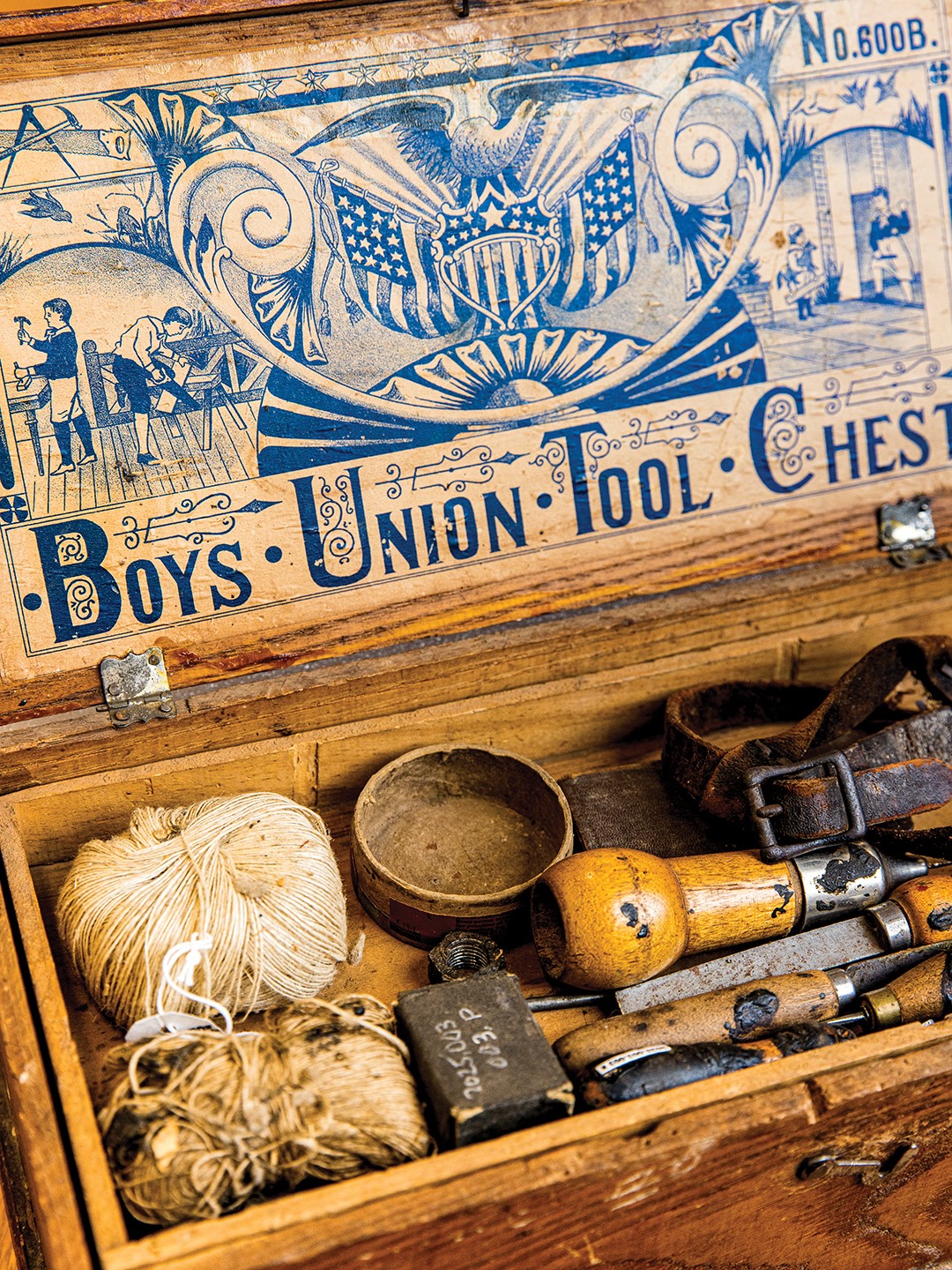
Through the Minnesota Historical Society’s Legacy Grants program, the Woodbury Heritage Society has unearthed local history, and has documented and researched thousands of items. This Boys Union Tool Chest is one of those items. Although it once held miniature toy tools, it now contains cobbler tools. Photos: Chris Emeott
A Minnesota Historical Society grant is making it possible to inventory thousands of items.
Thousands of historical items and photographs that are a part of the Woodbury Heritage Society’s (WHS) collection will now be properly inventoried thanks to the Minnesota Historical and Cultural Heritage Grants program. It has been a long time in the making. “The heritage society was started in 1983, and it was an outgrowth of the bicentennial committee [from] 1976. They started collecting and accepting contributions from Woodbury people,” says Tom Bielenberg, WHS board member. “So we knew we had over 5,000 things, but it hadn’t ever been inventoried the way that collections should be.”
The Minnesota Historical Society’s (MNHS) grant program, also known as Legacy Grants, supports projects that preserve Minnesota’s history. Joyce Flynn, WHS vice president, first applied to the MNHS grant program in 2022. Phase one was completed last year, when Rose Kubiatowicz, owner of Have Gloves Will Travel and museum consultant, inventoried the items found at Andy’s Bark Park, Heritage House and Miller Barn.

Thousands of items are being discovered and documented, including this traditional Swedish wooden mechanical toy known as a dancing bird balancing toy. Items like this have been produced in Sweden and other parts of Europe since the early 20th century, and are often sold as souvenirs or used in education to teach physics.
Several unique items have been unearthed, including a wooden box originally made for a children’s toy that now contains cobbler’s tools. Unopened for decades, the box, dated from 1910 or 1920, perfectly preserved both the toy’s paper insert and the tools inside. “[Kubiatowicz] said, ‘This is something that’s very rare and in excellent condition,’” Flynn recalls. Kubiatowicz has also done additional research on items, such as an old seed drill. “She found iron parts on it with the 1880 stamp, the company name and found out it was bought out by another company … We had good information, but she’s discovered a lot beyond this,” Bielenberg says.
The WHS received additional grants from the MNHS for future phases, including a $20,000 grant from the Arts and Cultural Heritage Fund to support phase two, which Kubiatowicz is currently working on. “These places have some very unique items, and it was fun to come across them,” she says. “A lot of them have to do with the depression era and the turn of the century … It’s fascinating.”
Kubiatowicz is currently inventorying nearly 1,500 items, including artworks, books and textiles, as well as nearly 800 archival documents found at the Resource Center; everything will be documented with its condition and location within the center and uploaded to an online database. “One of our main goals is to increase access to the people of Woodbury and beyond,” Kubiatowicz says. “[The project] will increase knowledge and access but also the [WHS’s] ability to care for the items.”
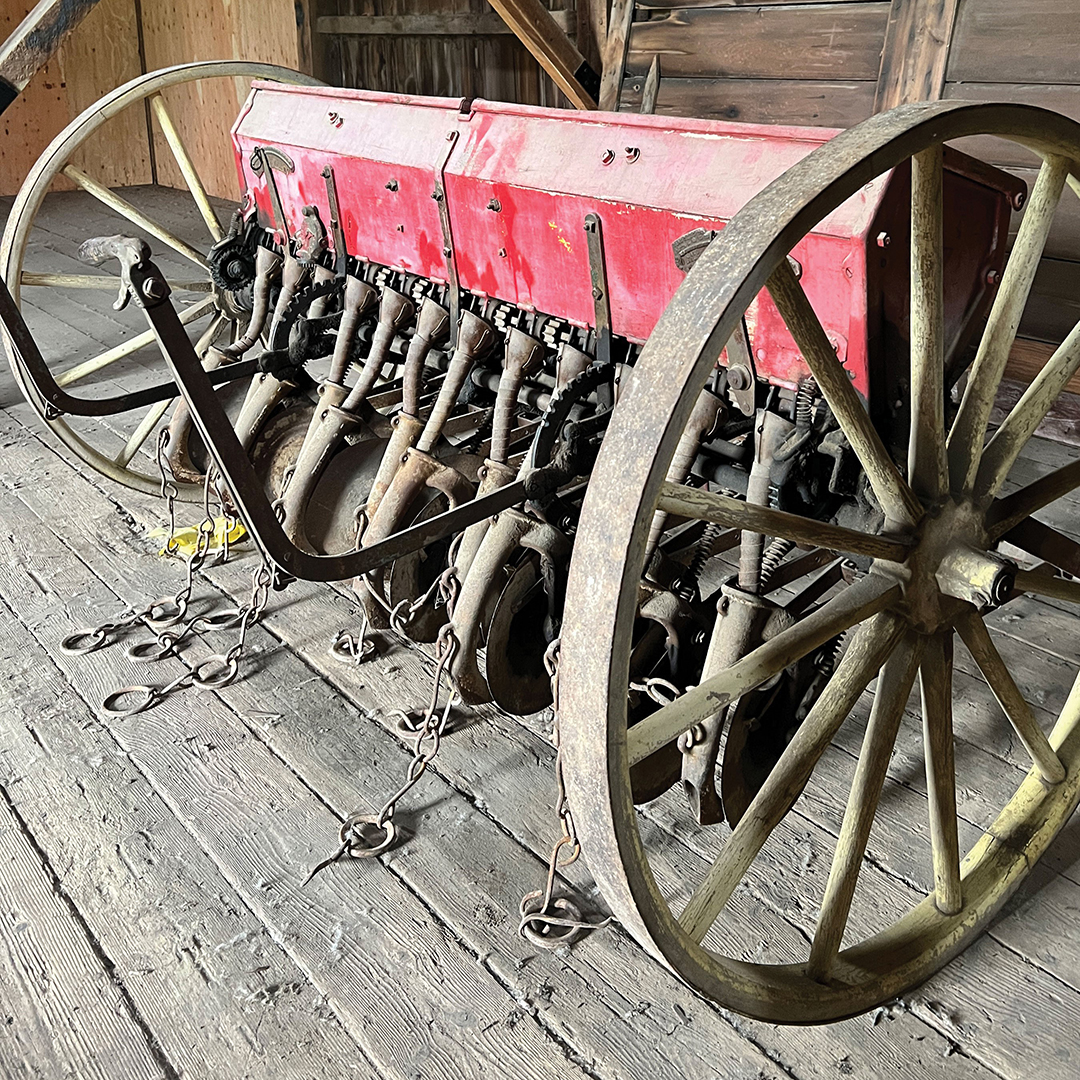
Museum consultant Rose Kubiatowicz researched this Van Brunt Seed Drill. Its elaborate mechanisms are used to plant seeds. Van Brunt was purchased by John Deere in 1911; after, drills were marketed as John Deere-Van Brunt Drills. However, this drill contains no John Deere markings. Photo: Woodbury Heritage Society
Bielenberg says he receives research questions and messages from people all over the country who are curious about their genealogy and Woodbury’s history. This project hopes to answer some of those questions by making everything available on a public database—which Flynn hopes to be completed in phase three or four, at the latest. “We were blessed. The Minnesota Historical Society has been good to us, providing us with information, guidance, advice and resources to use,” Flynn says. “They want us to gain this knowledge and have the community use it.”
Further down the line, the WHS hopes to create a “packet of information,” Flynn says, that schools can use to teach students about Woodbury’s history. For now, members are excited to preserve local history, one item at a time. “I want the future generations to respect the history of Woodbury,” Flynn says. “I want them to get excited about it and understand how those roots came to be, know how that’s impacted their life today and appreciate what they have because of what was done before them.”
Minnesota Historical Society
Facebook: Minnesota Historical Society
Woodbury Heritage Society
Facebook: Woodbury Heritage Society