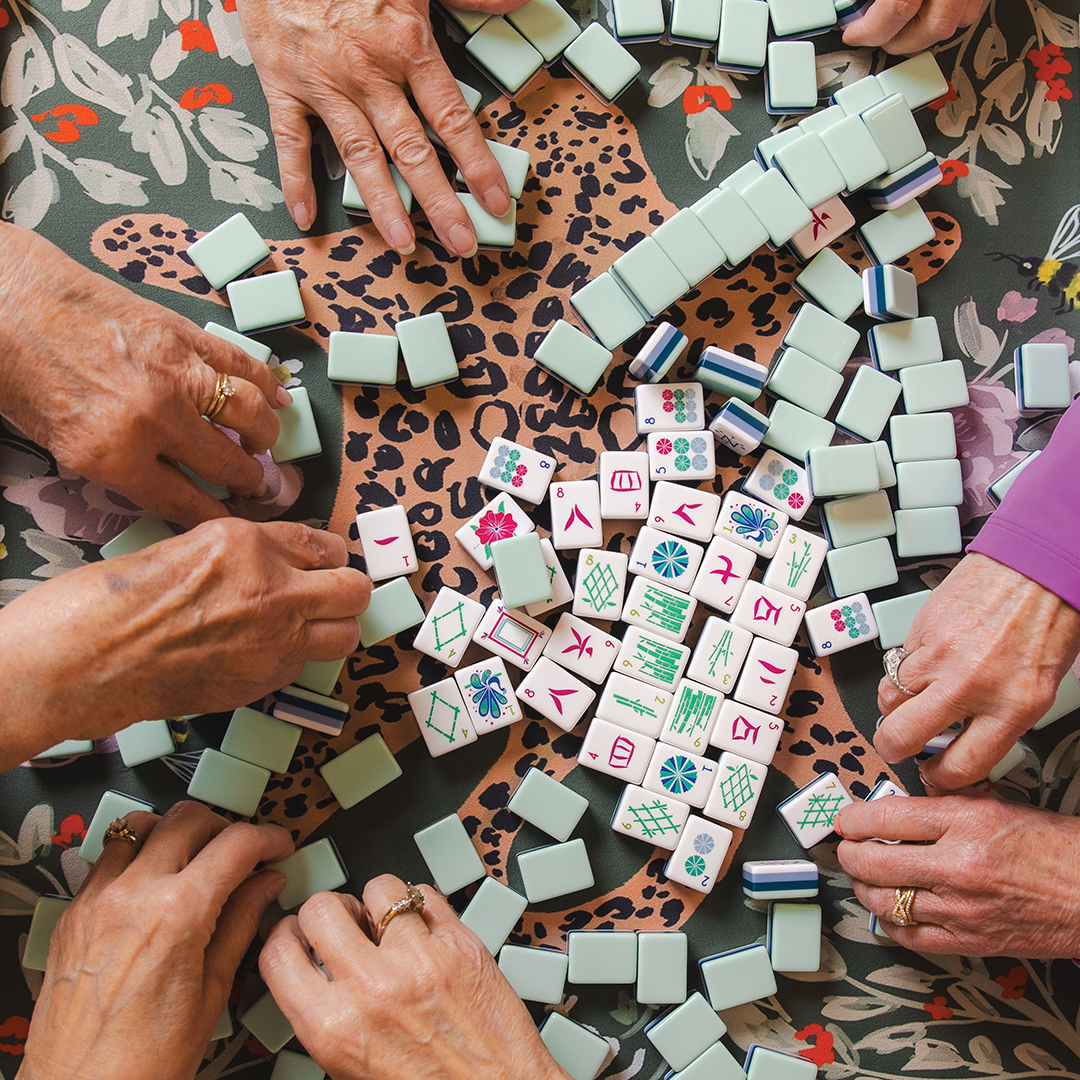
Mah Jongg is growing in popularity—and Woodbury has shown interest in the game. Photos: Chris Emeott
Local residents share their passion with a growing community of players.
Every Monday from 1 to 4 p.m., the Prairie Room at Woodbury’s Central Park fills with the sound of clacking tiles and friendly chatter as players gather for a weekly Mah Jongg meetup. Jennifer Gori, founder of the Woodbury Community Mahjong Group, says the welcoming atmosphere keeps new players pulling up chairs to the group. “Everybody was a beginner once,” the Woodbury resident says. Group member Mary Boss says they haven’t needed to actively market it—people just show up.
Gori and Boss both describe the game in the same way: “It’s creating order out of chaos.” In American Mah Jongg, the version played by the group, players begin with a disparate set of 13 tiles and work to match them to one of the patterns printed on an official Mah Jongg card. Gori says there are roughly 100 possible hands. Once a hand finally reflects one of those combinations, players call out “Mah Jongg.” “It’s luck and strategy,” Gori says. Games can last anywhere from eight to 15 minutes and can be played with two, three or four players at once.
Gori first learned how to play Mah Jongg during COVID-19, taking group lessons with three other beginners in Uptown Minneapolis. Boss learned the game over a single weekend while visiting a friend at her cabin. “I’ve only been playing for five years, but my husband would say I’m addicted,” Boss says.

Mary Boss (middle) is an active Woodbury Community Mahjong Group member who learned the game over a cabin weekend.
The two met years ago at a Mah Jongg tournament and became fast friends. Since then, they’ve taught countless Mah Jongg classes together across the Metro, utilizing a teaching method designed to ease beginners into the game. They also offer private lessons for those interested in more individualized instruction. Drawing on her professional background as a career trainer, Boss developed a step-by-step method that makes Mah Jongg less overwhelming for newcomers. “I immediately saw some interesting ways that I could teach and make it a little easier for people to learn,” she says.
Gori and Boss cite social connection as one of the game’s main benefits. “It’s a way to see friends that doesn’t involve eating,” Boss jokes, while Gori says, “I enjoy exposing people to something that’s going to be very social for them in a world that’s all about being on your phones.”
Mah Jongg also gives the brain a workout, engaging strategic thinking that Boss and Gori say many more seasoned players don’t use as often in their day-to-day lives. “It’s a very tactile and a very strategic game,” Gori says. “It’s using our brains at an age where we need to be using our brains more.”

Jennifer Gori learned Mah Jongg during COVID-19. She and Mary Boss have since gone on to teach classes across the Metro.
Although the game has traditionally been favored by older women, Boss has noticed more younger players attending her classes than ever before. “It’s very trendy right now,” she says.
For Gori, teaching Mah Jongg is ultimately about fostering connection. “I hope that if I teach somebody, they’re going to meet with other women, seek out community and be social,” she says. Boss concurs and says, “You can sit at home and play Sudoku by yourself, or you can get out, meet new people, play Mah Jongg and keep your mind sharp.”
Mah Jongg History
Mah Jongg gained a following in the United States in the 1920s when a group of Jewish women in New York fell in love with the game and began sharing it with others. From there, the game quickly soared in popularity. In 1937, the National Mah Jongg League was formed and began publishing the official Mah Jongg card still used today.
“The card changes every year, so it keeps it fresh,” Jennifer Gori says. Only hands printed on the current card can make a winning combination.

Mah Jongg can be played with two to four players and games last from eight to 15 minutes.
While American Mah Jongg has become a social staple in many communities, the game itself originated in China, where it has been played for centuries. Though the name is the same, the American and Chinese versions of the game differ slightly. Chinese Mahjong, for example, does not use a printed card to determine what makes a winning hand. Instead, players learn patterns and scoring rules rather than relying on a fixed list of hands. American Mah Jongg also includes jokers, while Chinese Mahjong does not.
Today, many countries have developed their own variations of the game, and at many tables, players incorporate their own house rules. Chinese Mahjong, however, remains the oldest and most widely played version.
Woodbury Community Mahjong Group
Facebook: Woodbury Community Mahjong Group